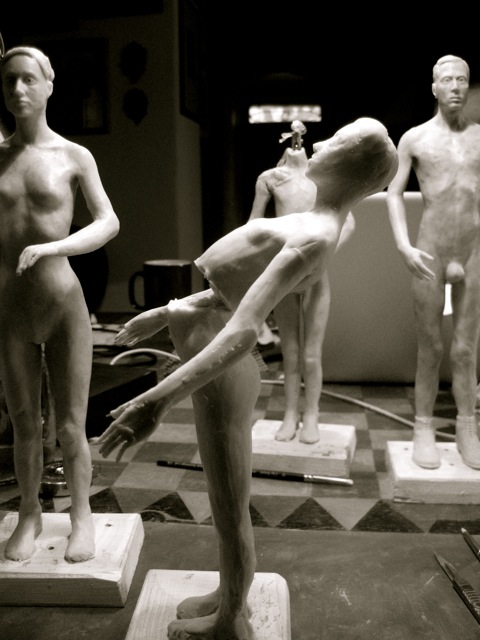
Wednesday, 14 March 2012

SEVENTEENTH ENTRY - Mould Making

On the 21st of February I packed my sculptures again, ordered materials, and traveled to the Scottish Borders to stay with Donald Holwill and work together in the quiet of his workshop in the remote land of Lauder, where the winds are soft, and the birds continue noisily after dusk.

My objectives were quite simple: do as much as possible, but the main priority being to cast foam versions of the figures, to be costume mannequins for Liz to work from.

There seem to be two main suppliers for special effects products (Bentleys with Smooth-On products, and MouldLife, supplying Polytek), with very small reasons to choose one over the other. It was suggested to me, for my needs, to go for Mouldlife, who were quite wonderfully helpful over the phone, and impressively efficient at sending the order to arrive in Lauder before I did.

Donald picked me up from Berwick Upon Tweed, a now relaxed and retired professor, and after settling in we commenced with some tests.

I had prepared a mockup test version of the grandmother, made from wax pushed into the fiberglass mould, a mould I had half made in Italy, and half, months later, in Surrey.

Below are images from the test run.
I wanted a silicone mould as a backup and also to be able to recast the figures in wax, from which I could demould the original sculpture without damaging it, to then make a new mould in hard resin.

 pins were stuck in the eyes to help keep the beads in place later during casting. A first layer of PlatSil© Gel 10 was applied with a soft brush.
 perhaps one or two more thin layers were applied, before a thickened version.
 Then a wall of oil based sulphur free Chavant clay was created half way around the figure. I had applied silicone keys (here seemingly deep sea monster nipples) in the last layer of silicone, so that the rubber mould would pop into place in the hard shell. 

EasyFlow 120 was used to make the shell. This is a two part resin mixed in 100 to 90 ratio, and which can be bulked with Alithihydrate, and thickened with Polyfibre. It is transparent during working time, which is good as this allows you to see any bubbles, and it cures to white.
 I was happy enough with this test at this point, so didn't bother with the other half of the shell.

the silicone skin came off of the sculpture perfectly, though the pins which were embedded into the ribber sliced through the eyelids of the wax original. We avoided this problem in the following moulds by removing the pins before demoulding.


 The silicone mould was successful, and an important test.

A poured resin test of the mould. Detail seemed perfect.

A new wall was built in clay for a two part resin mould. 
 Again, eye pins were inserted, and a thin layer of resin was brushed on.
More layers were then applied, and after the first side was done, the back side was made.


I embedded pieces of hex keys into the back of the mould that fit into the shoulder joints and suspend the armature.

I used the old fiberglass mould of the grandmother to test the polyurethane foam which I intended to use for the costume mannequins. The foam is the S5 High Density Soft Foam. It is very tricky to use, as it goes off in seconds, but after a few tries you get the results you want. Here I pushed some clay into the face in case the foam decided to not let go of the detail in the mould. I'd had some unpleasant experiences with hard polyurethane foam when making the puppets for Solo Duets. This soft one is much kinder, but still a little scary.


My first silicone skin. A test made in the grandmother mould.

The test results. A resin head made to test the silicone mould. A silicone skin, and a silicone skin filled with S5 foam. This made a very nice head to punch hair into, but as the foam is so unpredictable to use, I don't imagine I'll take that rout.
And two legs. The one on the left was made with a silicone skin, filled with S3 Low Density Soft Foam. I wanted to try this as a substitute for Foam Latex (which I lack the facilities for), as a light weight soft bulk for the puppets. However, being such a high expansion foam, filled with so much air, its bubbles affected the silicone with a strange older than old lady texture, and the foam didn't seem to bounce back to its original shape as much as it needed to. 
The leg on the right was made with solid PlatSil© Gel 10 silicone encompassing the armature. Amazingly it is soft enough that it does not resist the tension of the armature. Hence I believe I will get away with just building a light weight hard bulk skeleton onto the armature, under silicone skin which will be solid in the joints.

Donald and I spent the week on these tests, and on Friday morning we traveled into Edinburgh, where I participated in a crit with 2nd year students at ECA, and spent the weekend with Atzi, my composer friend, and my brother Tobias and Sophie.
Tobias and Sophie hosted a brilliant animators evening at Moat House, with Atzi, Ainslie Henderson, Will Anderson, Catriona Bruce, and Vitali Sichinava.

 Will Anderson, Catriona Bruce
 Atzi
Ainslie Henderson, Tobias Feltus
Sophie Gackowski, Vitali Sichinava, 
listening to Atzi read out loud a Hans Christian Andersen tale.
 Ainslie and Cat
Atzi and Vitali, a week later during Tobias' Roman birthday dinner.

During the weekend Tobias and I did some tests for eyeballs. I am unhappy with the shape of the beads I am using (which were pretty much the only round 4mm beads I have been able to find). They dip inwards around the hole, the opposite of what they should do to mimic an eye. This was so problematic during sculpture that I ended up turning Isolde's eyes so the hole was hidden within the head, which meant later needing to drill holes for the pins into the mould.
We tried sanding down the front of the bead flat, to the size of the iris, and then adding a drop of Araldyte as a lens, after painting the iris on the flat surface. It was a good experiment, but not satisfactory.

Tobias Feltus sanding irises into beads.


My dear friend and mentor, Professor Donald Holwill, in his kitchen in Lauder.

Wednesday, 11 January 2012

SIXTEENTH ENTRY - Boxing Day Rewrite

The Unattended Lessons has recently been undergoing changes.

On Boxing Day, during a morning walk, I rewrote the script.

I made changes to the protagonist's profession, clarified certain important aspects of his relationship with Isolde, and gave the film a rather different feel.

I had been working on these changes for a few weeks, but the day after Christmas things fell into place.

I believe it has been simplified and strengthened.

FIFTEENTH ENTRY - Eyes

Eyes.

Again, just like the mistake of making incorrectly proportioned armatures before sculpting, eyeballs should be made properly before anything else.

I found back in the days of Solo Duets that there seems to be no such thing as round glass beads the correct size. They say they are glass, but in reality they are cheap brittle moulded plastic, with a pearl effect coating. And they are the same damned ones you'll find in any shop, just packaged differently.
Has anyone else ever found actual round 4mm glass beads with tiny holes?

And apart from the fact that they are cheap plastic, they flatten around the hole, rather than protrude slightly as I would ideally want.
Trying to sculpting eyelids over a ball that flattens where it should protrude to mimic the eye's lens  is very frustrating.

So although they are ridiculously small, there must be a way to next time sculpt eyeballs the scale and shape I need, and cast them in resin or something.

Wednesday, 7 December 2011

FOURTEENTH ENTRY - words

It is clear that one of my main mistakes, as I have mentioned repeatedly, was to first build armatures, and sculpt the figures onto these. The bone structure I had created without enough study into form made it impossible to achieve the figures I desired. And because I thought things would be moving much quicker, and I was moving production down to Italy, I hurried to build a second armature for the young girl, a smaller one, again, before leaving and before sculpting.

I do wonder, however, how it would have been had I done things the "right" way. Today I thought to use the young girl's first armature in the place of the armature built for the old lady. This latter one had been made economically, and hence has wire arms. As I now have an extra full ball and socket armature sitting idle, I thought to use that for the old woman. The two armatures are roughly the same size, at least in height. Grandmother has wider hips, but this would not be a problem.
Instead, what of the full armature did not fit in the mould were the arms. She had been sculpted with wire in the place of the bulky elbow joints, and therefore can only work with wire, or with smaller joints, which of course I don't have.

This has inevitably brought me to worry about the fact that in all the puppets there are places where the skin only just covers the joint, and this will surely be very problematic when casting the silicone puppets over their skeletons.

Clearly, therefore, sculpting onto the armatures is the correct way to work, but only after first making quickly sculpted mockup to be sure of the right proportions to build the armature to.


Tuesday, 15 November 2011

THIRTEENTH ENTRY - a return


two views of Apartment II

the floor plan of both apartments, Assisi November 2010.


Liz's costume patterns, Assisi Feb, 2010

and the little disasters... She was so concentrated on the details of her work that she only noticed later that she had placed the sculpture down... face down...
Assisi, November, 2010

Something that bothers me about working with puppets this scale is the impossibility to have bones in the fingers. This is something I'm just trying, hoping that the rubber will prefer to bend at these thinner points. Assisi, February, 2011

In an earlier entry I mentioned how I found it suddenly easier to sculpt the head with hair, rather than imagining baldness. Here the face was well enough established that the hair could come back off. Assisi, February, 2011

Yet another problem with designing the armatures prior to the sculpture. Shortening the foot as much as possible against the established armature. Assisi, February, 2011


hands

I spent a good few hours on the internet looking at props for 1:6 scale action figures. Too many hours. I could have made my own props in that time.
In the end I ordered one set of silverware, but was not impressed by the quality, so worked on options of my own.


My first resin mould, started in Assisi (February 2011), and finished during a weekend at Longcross Studios (September 2011), outside of London, where I worked on the film World War Z.
It is not a masterpiece of a mould, but passable.
The resin was Diaspro Calk, from the Italian company Flockart ( www.flockcart.it ), suggested to me by the make-up designer Luigi Rocchetti.

Grandma staying moist, half way submerged in Deruta clay.

My first silicone mould test (in MouldMax 25), done in Cardiff, November 2010. I used a very intricate crab shell I found on the beach in the Gower, knowing it would be too intricate, but trying nonetheless to quickly patch up holes where undercuts would be too deep. I wanted to test an interesting object, even if this meant a failing test. It was quite unsuccessful, but I was impressed with the detail the silicone picked up from the newspaper it was poured onto (or whatever it was I had underneath).

Armature for the girl, kindly assembled by Joel Calvert at John Wright's studio (January 2011).
I decided she needed an entirely new armature, as the original did not suggest her correct age.


In November 2011, passing through Bristol after revisiting the Gower in Wales, I took the girl armature back to John Wright Modelmaking for a quick modification to reduce the gap between two joints so that the clavicle chest piece wouldn't stick out so much. This was the only modification I am allowing myself. The arms will have to stay long.


And here they are again, back in the box, traveling back to the UK in February 2011, when Liz and I moved to London and joined the crew of Marc Forster's 'World War Z'. The sculptures stayed in this box for many weeks. I finished the mould for the grandmother, taking advantage of a workshop, but started an oil painting to keep me myself during the weekends. I only just put the tools back to the sculptures in the last few days.


Saturday, 9 July 2011

Entry of Pause

In January, as sets were on their way and puppets ready for moulding, I fell into becoming part of the crew of 'World War Z', Paramount's greatest endeavour.
'The Unattended Lessons' is sadly on hold.

Wednesday, 15 December 2010

TWELFTH ENTRY - Workshop moves to Italy

On the 13th of November, a week after leaving Cardiff, Liz and I flew to Italy, where I plan to finish pre-production, and to shoot The Unattended Lessons.


The last week in Cardiff was spent making a disastrous first attempt at a rubber mould of the grandmother figure. My hope was to safely make silicone moulds of the three sculptures that were closest to being finished, so that they would not have to travel, and I could continue working on casts of them in Italy. One must not forget that the learning through making mistakes is an aspect of this process that I do love, and I shall leave it at that, without going into detail about what happened. This picture of the figures packed for travel will suffice.


Liz is currently in the process of creating the patterns for her meticulous designs, directly onto the wax sculptures.


For a few days the living room table became the canvas for designing the layout of the two mirrored apartments, furnished with the miniature wooden props my father has been working on in the winter evenings, when it is too dark to paint. My mother worked with me to establish a functional and realistic space, which still would permit me to be able to reach across a room during animation.

There were three specific moments in the script that were very important and influential in the design of the spaces, particularly in the positioning of the bedroom doors, and of the windows near the pianos.

Since these photos were taken, the stage has been built, and the set walls are cut and fitted with doors and windows. January will be the month of plaster, wallpaper, and floor tiles, and of Tobias' lighting design.


I was forced to start over with the little girl's sculpture. Her original armature, as I mentioned in the Ninth Entry, was simply too large, as it had been designed prematurely. So I re-sculpted her onto a wire armature. She finally looks the age she should be. Meet Isolte's daughter. She will need a new armature...

Her arms and torso were shortened when she arrived in Italy.


Young Rainer and Mr. Russeau, standing with the large face of "Tilda" (not my creation). Interesting to see the scale difference between the puppets of Solo Duets, and the new work, both trying to be accurately 1:6 scale...