Tuesday, 15 November 2011

THIRTEENTH ENTRY - a return


two views of Apartment II

the floor plan of both apartments, Assisi November 2010.


Liz's costume patterns, Assisi Feb, 2010

and the little disasters... She was so concentrated on the details of her work that she only noticed later that she had placed the sculpture down... face down...
Assisi, November, 2010

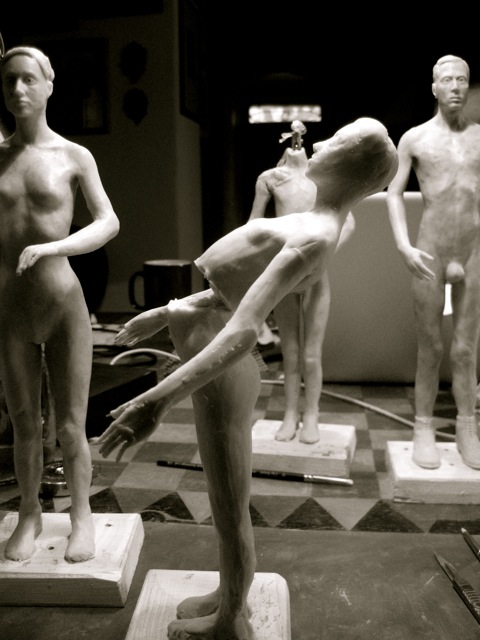
Something that bothers me about working with puppets this scale is the impossibility to have bones in the fingers. This is something I'm just trying, hoping that the rubber will prefer to bend at these thinner points. Assisi, February, 2011

In an earlier entry I mentioned how I found it suddenly easier to sculpt the head with hair, rather than imagining baldness. Here the face was well enough established that the hair could come back off. Assisi, February, 2011

Yet another problem with designing the armatures prior to the sculpture. Shortening the foot as much as possible against the established armature. Assisi, February, 2011


hands

I spent a good few hours on the internet looking at props for 1:6 scale action figures. Too many hours. I could have made my own props in that time.
In the end I ordered one set of silverware, but was not impressed by the quality, so worked on options of my own.


My first resin mould, started in Assisi (February 2011), and finished during a weekend at Longcross Studios (September 2011), outside of London, where I worked on the film World War Z.
It is not a masterpiece of a mould, but passable.
The resin was Diaspro Calk, from the Italian company Flockart ( www.flockcart.it ), suggested to me by the make-up designer Luigi Rocchetti.

Grandma staying moist, half way submerged in Deruta clay.

My first silicone mould test (in MouldMax 25), done in Cardiff, November 2010. I used a very intricate crab shell I found on the beach in the Gower, knowing it would be too intricate, but trying nonetheless to quickly patch up holes where undercuts would be too deep. I wanted to test an interesting object, even if this meant a failing test. It was quite unsuccessful, but I was impressed with the detail the silicone picked up from the newspaper it was poured onto (or whatever it was I had underneath).

Armature for the girl, kindly assembled by Joel Calvert at John Wright's studio (January 2011).
I decided she needed an entirely new armature, as the original did not suggest her correct age.


In November 2011, passing through Bristol after revisiting the Gower in Wales, I took the girl armature back to John Wright Modelmaking for a quick modification to reduce the gap between two joints so that the clavicle chest piece wouldn't stick out so much. This was the only modification I am allowing myself. The arms will have to stay long.


And here they are again, back in the box, traveling back to the UK in February 2011, when Liz and I moved to London and joined the crew of Marc Forster's 'World War Z'. The sculptures stayed in this box for many weeks. I finished the mould for the grandmother, taking advantage of a workshop, but started an oil painting to keep me myself during the weekends. I only just put the tools back to the sculptures in the last few days.


Saturday, 9 July 2011

Entry of Pause

In January, as sets were on their way and puppets ready for moulding, I fell into becoming part of the crew of 'World War Z', Paramount's greatest endeavour.
'The Unattended Lessons' is sadly on hold.

Wednesday, 15 December 2010

TWELFTH ENTRY - Workshop moves to Italy

On the 13th of November, a week after leaving Cardiff, Liz and I flew to Italy, where I plan to finish pre-production, and to shoot The Unattended Lessons.


The last week in Cardiff was spent making a disastrous first attempt at a rubber mould of the grandmother figure. My hope was to safely make silicone moulds of the three sculptures that were closest to being finished, so that they would not have to travel, and I could continue working on casts of them in Italy. One must not forget that the learning through making mistakes is an aspect of this process that I do love, and I shall leave it at that, without going into detail about what happened. This picture of the figures packed for travel will suffice.


Liz is currently in the process of creating the patterns for her meticulous designs, directly onto the wax sculptures.


For a few days the living room table became the canvas for designing the layout of the two mirrored apartments, furnished with the miniature wooden props my father has been working on in the winter evenings, when it is too dark to paint. My mother worked with me to establish a functional and realistic space, which still would permit me to be able to reach across a room during animation.

There were three specific moments in the script that were very important and influential in the design of the spaces, particularly in the positioning of the bedroom doors, and of the windows near the pianos.

Since these photos were taken, the stage has been built, and the set walls are cut and fitted with doors and windows. January will be the month of plaster, wallpaper, and floor tiles, and of Tobias' lighting design.


I was forced to start over with the little girl's sculpture. Her original armature, as I mentioned in the Ninth Entry, was simply too large, as it had been designed prematurely. So I re-sculpted her onto a wire armature. She finally looks the age she should be. Meet Isolte's daughter. She will need a new armature...

Her arms and torso were shortened when she arrived in Italy.


Young Rainer and Mr. Russeau, standing with the large face of "Tilda" (not my creation). Interesting to see the scale difference between the puppets of Solo Duets, and the new work, both trying to be accurately 1:6 scale...


Sunday, 24 October 2010

TENTH ENTRY - EYES

This is more than anything a reminder to myself, for when I read this in some future, looking for mistakes to skip whilst preparing a new piece.

It is never a nice thing to call someone a liar, but also never pleasant to be lied to. The people who declare the little plastic beads they sell to be glass, might as well see the fate that liars, if one believes it, are destined to. Whether or not there is a hell, and a particular place in it for all liars, of any degree, I do tend to believe in something like karma...

But more importantly, apart from the poor material, why on earth should one be stuck with little eyeballs that have a large flat area in the surface around the hole, making the process of sculpting eyelids around Round eyeballs quite frankly a joke.

Wednesday, 22 September 2010

NINTH ENTRY - LITTLE HEAD

Again, relating back to the Fourth Entry, I am plagued by my great mistake. The armature for the child is simply too big. The character I have in mind needs to be smaller.

Whilst sculpting I have learned, whether it is a limitation of my own, or simply normality, that my mind is unable to ignore parts of the body, and mentally replace them with what is underneath. Just as it is not the same to sculpt a naked figure from a clothed model, it is very difficult, and frankly quite pointless to sculpt a head without hair.... I assure you, once I added a blob of wax to act as hair, suddenly the face and head started to make more sense...

R. is starting to look like himself....


Friday, 6 August 2010

EIGHTH ENTRY - BRAIN SURGERY

Prior to beginning sculpture, I had imagined I would be able to create some bulk that would act, in some areas, the same way the human skeleton defines the shape of the outer body.
In any case, I knew light bulk would be needed to lighten the silicone cast puppet, and as I had started working backwards, beginning with the armature, it seemed logical to continue in this rout.


Today I decided to carefully surgically remove the hard skull from inside Russeau's head, which had been causing great limitations and annoyance.
I enjoyed this, as it went smoothly without damaging the face, and the result was a great sense of freedom. Now his head could find its right shape.


Thursday, 5 August 2010

SEVENTH ENTRY - HANDS


I have struggled with locating and choosing the right wire to use for the hands. Steel florist wire, wrapped in cotton seems to be used, but it also seems strangely hard to find, and in my tests, thin twisted aluminium wire seemed to last the longest.
So, though I never reached a final decision, I had to assemble hands of some sort to complete the figure in sculpting, and I went with 0.56mm twisted aluminium.
Hands are a pickle, as they are very small and delicate, and tend to break very easily. Hence one must plan for the very likely eventuality of breakage. I don't recall if fingers ever broke during the making of Solo Duets, but the wrists most certainly did break. Therefore, this time I decided it was important to use steel ball joints in the wrists, rather than wire all the way through to the forearm.
For easily replaceable or mass produced hands, as always there are various possibilities, thought of and yet to be thought of.
With a copper plate soldered to the tiny rod of the hand, last March Tobias created the possibility for a copper "sandwich" mechanism tightened with a screw, whilst I tried just using polimorph, hoping for more ease and speed.
I didn't like the rigidity of the "sandwich" device, and it's bulkiness, and the polimorph did not reveal itself to be at all easy. For some reason I took a liking to the stuff, and tend to optimistically try it in virtually everything.
Last week I decided my figures looked ridiculous without hands, due to waiting for who knows what sort of heavenly sign to help with a decision about what wire to use, therefore I assembled some using araldite. The araldite didn't seem to hold the rod well enough, and, though it fell nicely onto the wire with the help of gravity, it also bulked up too much. It could have been sanded down afterwards, but this is very difficult to do without damaging the aluminium. I switched to milliput.

I used wax to hold the wire digits in place... This, I thought, was rather clever...
redone in milliput (onto newspaper, which left a trace)..

starting to look human...